Project Overview
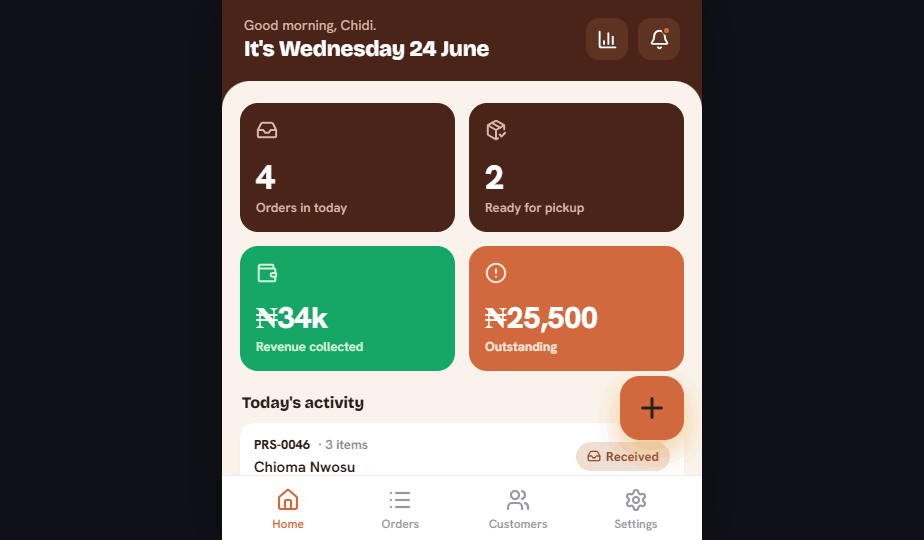
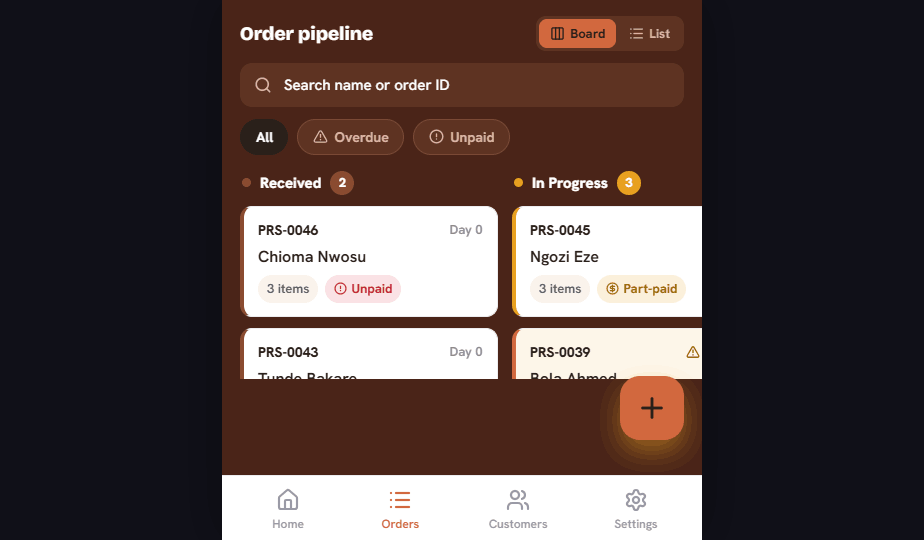
Crisp is a mobile-first order manager built for small laundry and dry-cleaning shops in Nigeria. Shop owners take orders, track garments through every stage from received to collected, notify customers on WhatsApp, log payments, and manage staff and branches, all from a single app they can run from their phone.
Most laundry shops in Nigeria run on a notebook, a WhatsApp chat, and memory. Crisp replaces that with structure, without asking the owner to change how they already work.
The Problem
Small laundry and dry-cleaning shops handle dozens of garments a day across multiple customers, with no system to track any of it beyond a handwritten ticket or a memory of who dropped off what.
- Lost garments. No record of what came in, who it belongs to, or what stage it is at
- Missed pickups. Customers forget their orders are ready because no one tells them
- Payment confusion. Cash and transfer payments tracked nowhere, disputes are common
- No staff accountability. Multiple staff handling orders with no shared record
- No multi-branch visibility. Owners running more than one location have no combined view
What I Built
A full-stack PWA covering order intake, garment tracking, customer notifications, payments, and staff management, tuned for how a small shop actually operates day to day.
Tech Stack
Key Product Decisions
Crisp handles two entirely different kinds of money, and the product keeps them apart on purpose. The shop's own customer payments, cash or transfer for a dry-cleaning order, are simply recorded in-app for the owner's own record. Crisp itself never touches that money. Separately, the shop owner pays Crisp a recurring subscription fee via Paystack for using the software. Conflating the two would have meant taking on payment-processing risk and complexity the product never needed.
Account access uses a phone number and a PIN rather than an email and password, matching how shop owners already think about their identity. It also avoids the cost and delivery reliability problems of SMS-based verification entirely, a real constraint for a bootstrapped product serving small businesses on tight margins.
The PWA frontend and the Hono API backend live in a single npm workspaces monorepo. For a solo founder building both sides of the product, sharing types and tooling across one repository kept iteration fast without the overhead of managing separate codebases.
Milestones Achieved
- ✦ Full monorepo built and shipped, PWA frontend plus API backend
- ✦ Frontend live on Vercel at crisp.com.ng, backend live on Railway
- ✦ Order pipeline covering all four garment stages, received to collected
- ✦ WhatsApp customer notifications wired end to end
- ✦ Paystack subscription billing integrated for the Pro plan
- ✦ Demo business seeded with staff, customers, and orders across every stage for external review
What I Learned
Dropping SMS verification wasn't a corner cut. It was a decision to spend the product's limited resources on the parts of the experience shop owners would actually feel, not on infrastructure they would never notice.
Nigerian small businesses already run on WhatsApp. Routing customer notifications through it, instead of email or in-app alerts nobody checks, was the single highest-leverage decision in the product.
Separating the shop's customer payments from Crisp's own subscription revenue, even though both are small amounts, kept the product's scope honest and made it far easier to reason about later.
See it Live
Crisp is live and running for real laundry and dry-cleaning shops in Nigeria.